
The Real Cost of Always Hiring “The Best People”
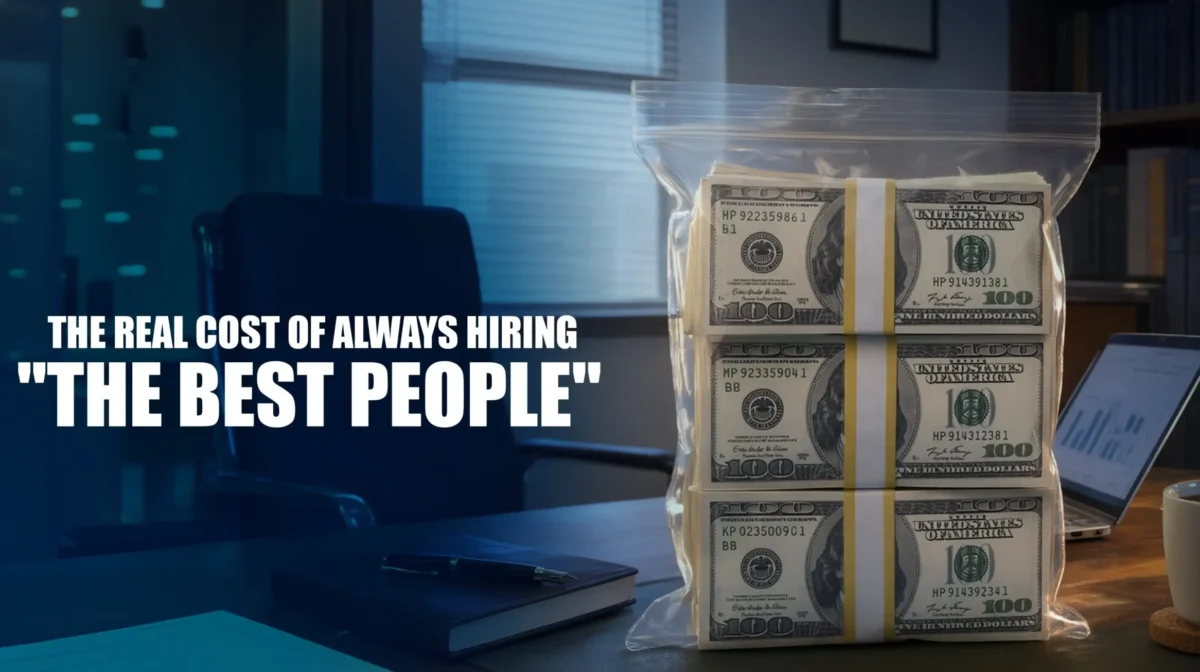
Why great organizations don’t win by chasing superstar employees—they win by building systems where talent can consistently thrive.
The Myth of Hiring “The Best”
For many organizations, hiring “the best people” has become the ultimate business strategy.
Job descriptions become longer, expectations become higher, and recruitment budgets continue to grow—all in pursuit of exceptional talent.
The assumption is simple: if you hire exceptional people, exceptional results will naturally follow.
Yet research suggests that organizational performance depends on far more than individual talent. According to Gallup, managers account for up to 70% of the variance in employee engagement, highlighting how leadership and organizational systems often have a greater impact on performance than recruitment alone.
But what if the real competitive advantage isn’t hiring better people?
What if it’s creating an environment where people can consistently perform at their best?
Some of the world’s most successful organizations don’t outperform because they hire the smartest people in the room. They outperform because they’ve built systems that enable talented individuals to thrive.
The real competitive advantage isn’t finding heroes. It’s building organizations that don’t depend on them.
The Superstar Hiring Myth
There’s nothing wrong with hiring outstanding talent.
The problem begins when organizations believe talent alone can solve structural problems.
A brilliant employee cannot compensate for poor leadership.
An experienced manager cannot fix broken communication.
A highly skilled specialist cannot thrive inside a culture that discourages initiative, collaboration, and continuous learning.
When organizations expect individuals to compensate for weak systems, they create an endless hiring cycle—constantly searching for the next “perfect candidate” instead of improving the environment those candidates will enter.
Eventually, even the best people become frustrated.
Not because they lack capability.
But because the organization limits their ability to perform.
Hiring becomes a temporary solution to what is fundamentally a long-term organizational challenge.
A Real-World Example: Microsoft Didn’t Need Better Talent
One of the strongest examples comes from Microsoft.
Long before Satya Nadella became CEO, Microsoft had no shortage of brilliant engineers, product managers, and business leaders. Talent was never the company’s biggest challenge.
The real issue was the environment.
Internal competition, organizational silos, and a culture that rewarded being the person with the right answer made collaboration increasingly difficult. Innovation slowed—not because employees lacked ability, but because the system limited how effectively they could work together.
When Nadella took over in 2014, he didn’t respond by launching a massive hiring initiative.
Instead, he focused on transforming the organization’s mindset.
He introduced a culture centered on learning rather than proving expertise, encouraged cross-functional collaboration, and shifted Microsoft’s philosophy from a “know-it-all” culture to a “learn-it-all” culture.
Microsoft’s turnaround wasn’t driven by a hiring strategy—it was driven by a leadership strategy.
The company proved that transforming how people think and work together can unlock more value than simply adding more talent.
The Hidden Costs Nobody Talks About
The obsession with hiring top talent comes with costs that rarely appear on financial reports. While organizations often celebrate successful recruitment, they rarely measure what this strategy may be costing them in the long run.
Rising Recruitment Costs
The stronger the profile you’re chasing, the more expensive it becomes to attract and retain that person.
Higher salaries, signing bonuses, premium benefits, and lengthy recruitment cycles all increase hiring costs. Yet these investments don’t necessarily translate into stronger organizational performance.
When hiring becomes the primary growth strategy, organizations often overlook investments that generate longer-lasting value—such as leadership development, employee learning, and operational excellence.
Overdependence on Individuals
Organizations that rely heavily on star performers become increasingly vulnerable.
Critical knowledge, key client relationships, and major decisions often become concentrated in a handful of individuals. While this may produce short-term wins, it creates long-term risk.
When one of those individuals leaves, projects slow down, knowledge disappears, and teams struggle to maintain momentum.
Strong organizations should never depend on a single person to sustain performance.
Collaboration Begins to Decline
An excessive focus on individual excellence can unintentionally weaken teamwork.
When recognition is tied primarily to personal achievement, knowledge sharing becomes less common, collaboration decreases, and employees become more protective of their expertise.
Over time, organizations create internal competition instead of collective success.
Ironically, the pursuit of exceptional individuals can reduce the performance of the entire team.
Great Organizations Build Systems, Not Heroes
The world’s most successful organizations understand a principle that many businesses overlook:
People create value. Systems multiply it.
Hiring exceptional employees is important, but it is only one part of sustainable success.
High-performing organizations invest just as much in building effective systems as they do in attracting talented people.
They create clear processes.
They establish consistent decision-making frameworks.
They develop leaders who coach rather than control.
They build cultures where learning, collaboration, and accountability become everyday habits—not occasional initiatives.
When these systems are in place, average performers improve.
High performers become even more effective.
And organizational success no longer depends on a handful of extraordinary individuals.
As a result, performance becomes scalable, repeatable, and sustainable.
The strongest organizations don’t compete for talent alone.
They compete by creating environments where talented people choose to stay, grow, and succeed.
Invest in the Environment, Not Just the Employee
Hiring should never be viewed as the finish line.
It’s only the beginning.
Organizations that consistently outperform their competitors understand that talent develops—or declines—based on the environment surrounding it.
A supportive culture, effective leadership, continuous feedback, and opportunities for growth have a greater long-term impact than recruitment alone.
The question is no longer:
“Can we hire great people?”
It becomes:
“Can we create an organization where great people can consistently do great work?”
That shift in thinking changes everything.
A Better Question for Leaders
Instead of asking:
“How do we hire better people?”
Leaders should begin asking:
- Are our systems helping people succeed?
- Do our managers develop talent—or simply manage performance?
- Does our culture encourage learning, collaboration, and innovation?
- Are we creating an environment where talented people want to stay?
- Are we building an organization that can succeed beyond individual contributors?
These questions reveal far more about future business performance than any recruitment strategy ever could.
Final Thoughts
Exceptional organizations are rarely built through exceptional hiring alone.
They are built by leaders who understand that sustainable success comes from combining capable people with effective systems, thoughtful leadership, and a culture that enables talent to flourish.
Finding great people will always matter.
But building an organization where great people can consistently do their best work?
That’s what creates a lasting competitive advantage.
Because in the end, organizations don’t become extraordinary by hiring a few extraordinary people.
They become extraordinary by helping people achieve extraordinary results together.
Build Organizations That Don’t Depend on Superstars
Recruiting exceptional talent is only one piece of the equation.
Sustainable success comes from creating organizations where people think strategically, collaborate effectively, and continuously improve.
At Innovation Gate (IG), we believe professional growth goes beyond earning a degree or adding another credential to your CV.
It’s about developing the leadership capabilities, strategic thinking, and business perspective needed to create meaningful impact within an organization.
Through our academic and professional pathways, IG connects ambitious professionals with opportunities designed to support their leadership development, strategic growth, and long-term career progression.
Because stronger organizations don’t happen by chance.
They are built by better leaders.
Explore your next opportunity with Innovation Gate and take the next step toward building the skills that move organizations—and careers—forward.